
India and Canada solidify their partnership with a landmark uranium supply agreement and discussions to finalise a comprehensive economic partnership, signaling stronger ties and cooperation on key global issues.
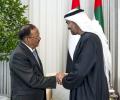
India is the only significant power that all parties trust, or at least do not distrust, notes former defence secretary Ajay Kumar.
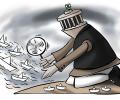
India finalised a free trade agreement with the UK, its 16th so far as the country aimed at boosting bilateral trade and investments. The other regions and countries with which India has signed such agreements include the four-nation European bloc EFTA, Japan, Korea and Australia.

Prime Minister Narendra Modi will visit the UAE, the Netherlands, Sweden, Norway and Italy to deepen India's bilateral ties amid geopolitical changes.

India and Israel have elevated their relationship to a special strategic partnership, focusing on enhanced cooperation in trade, technology, and defense, while also addressing regional peace initiatives.
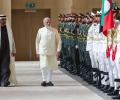
Prime Minister Narendra Modi has offered India's support to bring peace to West Asia during talks with UAE President Sheikh Mohamed bin Zayed Al Nahyan. Both countries signed agreements to strengthen strategic collaborations in energy and defence.

The proposed trade deal with the 27-nation European Union (EU) is expected to provide zero-duty access to the $95 billion European market for Indian textile and apparel manufacturers. Currently, India's share of the European market is just 6 per cent, or $5.5 billion.

India needs to increase the investment rate to 34-35 per cent from 31-32 per cent currently to achieve a growth rate of 7 per cent and above, said S Mahendra Dev, chairman, economic advisory council (EAC) to the Prime Minister, on Wednesday.

The Indian government informed Parliament that India and the US are engaged in negotiations for a mutually beneficial multi-sectoral bilateral trade agreement. The two countries also cooperate on strategic, economic, and defense matters, managing divergences through high-level dialogues.

Both India and the EU are likely to announce a conclusion of trade talks on January 27.

Prime Minister Narendra Modi emphasized the strong partnership between India and the UK, highlighting its importance for global stability and economic progress amidst global uncertainty. Discussions covered trade, defense cooperation, and geopolitical issues.

'The biggest point of contention is market access for US agricultural and dairy products.'

Govt policy, not trade with Asean, stifles manufacturing.
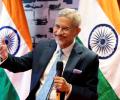
'The logic every one of our neighbours must realise is that working with India will give you benefits, and not working with India has a cost.'

In their talks, Modi and Merz are likely to deliberate on trade and investment ties as New Delhi is looking at deepening economic engagement with Europe against the backdrop of Washington's 50 percent tariff on Indian goods, people familiar with the matter said.
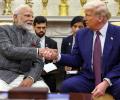
'India's farmers will be unable to compete with the US, given the subsidies that the latter provides its farmers.'

China and Pakistan concluded their strategic dialogue, reiterating their opposition to unilateral actions in South Asia and discussing Kashmir, Afghanistan, and trilateral cooperation.
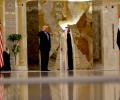
'In the Indian government there are no illusions about the United States reliability or the possibility of having any kind of preferential treatment from Washington when it comes to trade.'

India on Thursday signed a free trade agreement, officially dubbed as the Comprehensive Economic and Trade Agreement (CETA), with the UK - its 16th trade pact so far - as the country aims to boost bilateral trade and investments.

Experts believe it would be far-fetched to believe that Riyadh would support Pakistan militarily in any conflict with India, which has robust strategic and economic relations with Saudi Arabia.
Addressing the MPs in Parliament, he favoured early conclusion of the Comprehensive Economic Partnership Agreement to push economic relations and raise the volume of bilateral trade to $20 billion in the next three years.

Countries that have signed the RCEP agreement can start negotiations with India for joining the pact once New Delhi submits a written request stating its intention for the same, according to a declaration. On November 4 last year, India walked out of mega free trade agreement RCEP (Regional Comprehensive Economic Partnership) as negotiations failed to address New Delhi's outstanding issues and concerns. The remaining 15 member countries have signed RCEP agreement and have stated that the pact would remain open to India.
Keen to forge all-weather ties with India, Sri Lankan President Mahinda Rajapaksa has lauded the developmental work undertaken by the country in the war-ravaged northern region and vowed not to allow his nation's soil to be used against it.

The 2 countries signed 15 agreements including one on defence cooperation after Prime Minister Narendra Modi held 'productive discussions' with President Joko Widodo.

External Affairs Minister S Jaishankar on Friday met Akie Abe, the wife of Japan's late Prime Minister Shinzo Abe and recalled the late premier's invaluable contribution to the advancement of India-Japan relations.
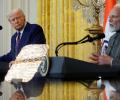
'But I don't think the government is in a great hurry to sign the BTA.'

Asked for China's comments on India not joining the RCEP deal over concern of cheap Chinese products potentially harming its domestic industry, Chinese foreign ministry spokesman Geng Shuang told the media in Beijing on Tuesday that China welcomes India joining the deal.
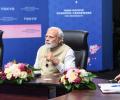
As US President Joe Biden launched a new trade deal with 12 Indo-Pacific nations, including India, to enhance trade, economic and investment opportunities, China, which sees the pact as a threat to its dominance in the region, went on the offensive against it, promising more opening up, while the official media here termed it as "economic Nato".
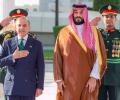
'Saudi-Pak defence pact is to anchor the defence and security of Saudi Arabia and not Pakistan, per se, with Islamabad being the junior partner.'
There were concerns in Sri Lanka about the huge trade imbalance.
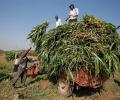
The World Bank on Tuesday raised the growth forecast for the Indian economy to 7 per cent for the current fiscal year on the back of recovery in agri sector and rural demand. World Bank had in June projected India to grow at 6.6 per cent for FY24. According to the World Bank Report released on Tuesday, India's growth continues to be strong despite a challenging global environment.
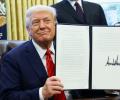
The Trump trade shock is a chance to push long-overdue reforms, rather than tinker with tariffs to appease the US, suggests M Govinda Rao.

Indian firms feared they would lose business if US ratified the Trans-Pacific Partnership agreement with 11 other countries.
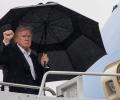
'When Prime Minister Modi met President Trump, they agreed to initiate a bilateral trade dialogue.' 'It makes sense to give these negotiations a chance.'
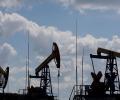
An influential US lawmaker claims his visit to India helped catalyze "early signals" that New Delhi may reduce its imports of Russian oil, a step he described as "meaningful" in weakening Moscow's ability to fund its war in Ukraine.
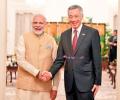
Modi hailed the close defence cooperation between the two countries and welcomed the completion of the logistics agreement between the two navies.

Global confidence in India has been restored, says Modi.
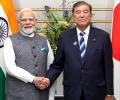
Prime Minister Shigeru Ishiba's sudden resignation after only a year in office has thrown Japan into political turmoil, raising doubts about how the country will handle economic and regional challenges, observes Dr Rajaram Panda.
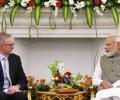
The matter came up for discussion during their wide-ranging dialogue that was aimed at expanding overall ties.

Sources said China was forcefully pushing for inking the deal during the RCEP summit later in the day, which was seen as an attempt to counter-balance the impact of its lingering trade war with the US as well as to project the region's economic might to the West.
 © 2026 Rediff.com - Advertise with us - Disclaimer - Privacy Policy - Sitemap - Feedback - About us - Terms of use - Grievances